
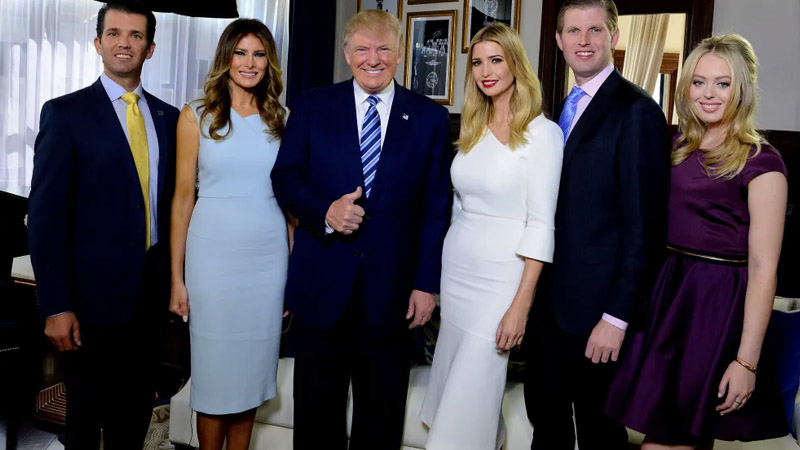
President Donald Trump’s family has made billions from a new cryptocurrency venture launched during his second term, raising sharp concerns among analysts and critics.
According to a report Monday in The Wall Street Journal, the family’s token WLFI began trading this week and quickly boosted their wealth by an estimated $5 billion—an amount that eclipses the value of their decades-old real estate empire. The token was issued by World Liberty Financial, a firm run by Trump’s sons, Donald Trump Jr. and Eric Trump. The company was co-founded by Zach Witkoff, the son of Trump’s chief envoy Steve Witkoff.
Early investors in WLFI were able to buy tokens for as little as $0.015 last year, the Journal reported. The Trump family, including the president himself, controls roughly one-quarter of the entire supply of tokens.
Despite the initial surge, WLFI’s price tumbled shortly after launch, falling from around $0.32 to less than $0.22 within hours, according to data from CoinMarketCap. The sharp decline prompted some observers to accuse the family of engaging in a “rug pull,” a common crypto scam in which project creators cash out and leave investors with worthless tokens.
Criticism has mounted across political and financial circles. On their YouTube program Pod Save America, commentators Jon Favreau and Jon Lovett blasted the venture. Favreau called the effort a “crypto grift,” while Lovett was even more blunt. “This is just a straight-up f—— scam,” he said.
The WLFI project is not the family’s first foray into digital currency. Trump relatives have also backed novelty coins tied to their names, including a Trump memecoin and a Melania memecoin. In addition, Trump Media—the parent company of Truth Social—has disclosed cryptocurrency holdings of its own.

The venture underscores the Trump family’s growing shift away from traditional real estate into high-risk, high-reward digital assets. Supporters argue the move reflects savvy adaptation to changing markets, while critics view it as a dangerous scheme capitalizing on the volatile crypto space.
Skepticism has also intensified because of the family’s heavy concentration of holdings in WLFI. With one-quarter of the token supply in their control, questions remain about whether smaller investors will ultimately bear the brunt of price collapses.
For now, WLFI remains in circulation, but the backlash highlights broader concerns about the lack of oversight in cryptocurrency markets. With billions already on the line, the Trump family’s gamble has once again placed them at the center of financial and political controversy.